
Woodland Caribou: The Flagship Species
No animal is more closely associated with Canada's boreal forest than the woodland caribou (Rangifer tarandus caribou). Unlike the barren-ground caribou of the Arctic tundra, woodland caribou occupy forested terrain year-round, moving across large home ranges to track the availability of terrestrial lichens — their primary winter food source — in old-growth conifer stands.
Woodland caribou require extensive old forest because terrestrial lichens of the genera Cladonia and Cladina take decades to develop to harvestable quantities. A stand disturbed by logging or fire is effectively unavailable for caribou winter range for 50 to 100 years. This dependency on old, continuous forest makes the species an exceptionally sensitive indicator of boreal landscape integrity.
The relationship between woodland caribou and wolves is one of the better-studied predator-prey dynamics in the boreal. Wolves (Canis lupus) historically coexisted with caribou through a spatial separation strategy: caribou avoided the highest-risk areas, which wolves patrolled in relation to moose — the wolf's primary prey. Industrial development that fragments the forest and creates linear features such as roads, seismic lines, and transmission corridors disrupts this spatial separation, bringing wolves and caribou into closer proximity with documented effects on caribou survival rates.
Environment and Climate Change Canada has identified boreal woodland caribou as threatened under the Species at Risk Act. Provincial and territorial governments hold primary responsibility for range planning, and the pace and content of recovery efforts vary considerably across jurisdictions.
Canada Lynx: The Cycle-Driver
The Canada lynx (Lynx canadensis) and the snowshoe hare (Lepus americanus) are perhaps the most famous predator-prey pair in North American ecology. The roughly 10-year population cycle of snowshoe hares — documented through Hudson's Bay Company fur trade records going back to the early nineteenth century — drives a corresponding cycle in lynx numbers with a lag of one to two years.
Lynx are obligate specialists on snowshoe hare where the two species co-occur, and their population dynamics are tightly coupled to hare abundance. When hare populations crash — due to a combination of overgrazing of winter browse plants and increased predation pressure — lynx populations follow. The mechanism involves not only direct starvation but also reduced reproductive success: pregnant females in poor condition produce smaller litters, and kitten survival drops sharply.
The lynx's large, well-furred paws function as snowshoes, allowing effective pursuit of hares through deep snow conditions that disadvantage other predators such as coyotes. This specialization makes lynx poorly suited to boreal regions where snow conditions have changed, and researchers have noted southward range contractions and range changes in areas experiencing warmer winters with more freeze-thaw cycles that reduce snow depth and alter its structure.
In Canada, lynx occupy most of the boreal zone from Newfoundland to Yukon and British Columbia. The species is listed on Schedule 1 of the Species at Risk Act as Special Concern in some southern portions of its range, though core boreal populations remain robust in most regions.
The Wolverine: Low Density, Wide Range
The wolverine (Gulo gulo) occupies the least populated ecological niche among boreal carnivores. A single adult wolverine may require a home range of several hundred square kilometres — an expanse driven by its diet of carrion, cached food, and opportunistically hunted prey including snowshoe hares, ground squirrels, and even ungulates weakened by deep snow or injury.
Wolverines are famous in naturalist literature for strength disproportionate to their size and for their ability to dominate carcasses against larger predators. They cache food under snow and return to these stores over weeks, a behaviour that gives them a survival advantage during mid-winter when active prey is scarce.
Denning wolverines require persistent spring snow cover — females select denning sites in areas where snowpack remains stable through April and into May, which insulates the den from temperature fluctuations. Climate projections that model reduced spring snowpack in parts of the boreal and sub-alpine zone raise questions about long-term denning habitat availability, and this has been a focus of conservation biology research in both Canada and the western United States.
Gray Wolf: Apex Predator and Ecosystem Engineer
The gray wolf (Canis lupus) remains a functioning apex predator across most of the Canadian boreal, in contrast to its highly reduced status in the contiguous United States and much of Europe. Wolf packs in the boreal primarily hunt moose (Alces alces), white-tailed deer at southern margins, woodland caribou where distributions overlap, and beavers during open-water seasons.
The ecological effects of wolves extend beyond their direct predation. Research in North American national parks and other systems has shown that predator presence alters prey behaviour as well as prey numbers — an effect sometimes described as the "landscape of fear." Where wolves are present, moose may avoid riverine areas during certain conditions, reducing browsing pressure on riparian vegetation. Whether this behavioural effect operates at a meaningful scale in the vast boreal landscape remains a subject of scientific discussion.
Wolf management in Canada is provincially administered and varies from complete protection in national parks to regulated hunting and trapping in most provincial and territorial jurisdictions. In areas where woodland caribou recovery plans are being implemented, provincial governments have in some cases employed lethal wolf management as a short-term measure intended to reduce predation pressure while habitat is restored — a practice that has generated significant scientific and public debate about the relative emphasis placed on predator management versus industrial footprint reduction.
Great Grey Owl: Silent Predator of the Boreal Interior
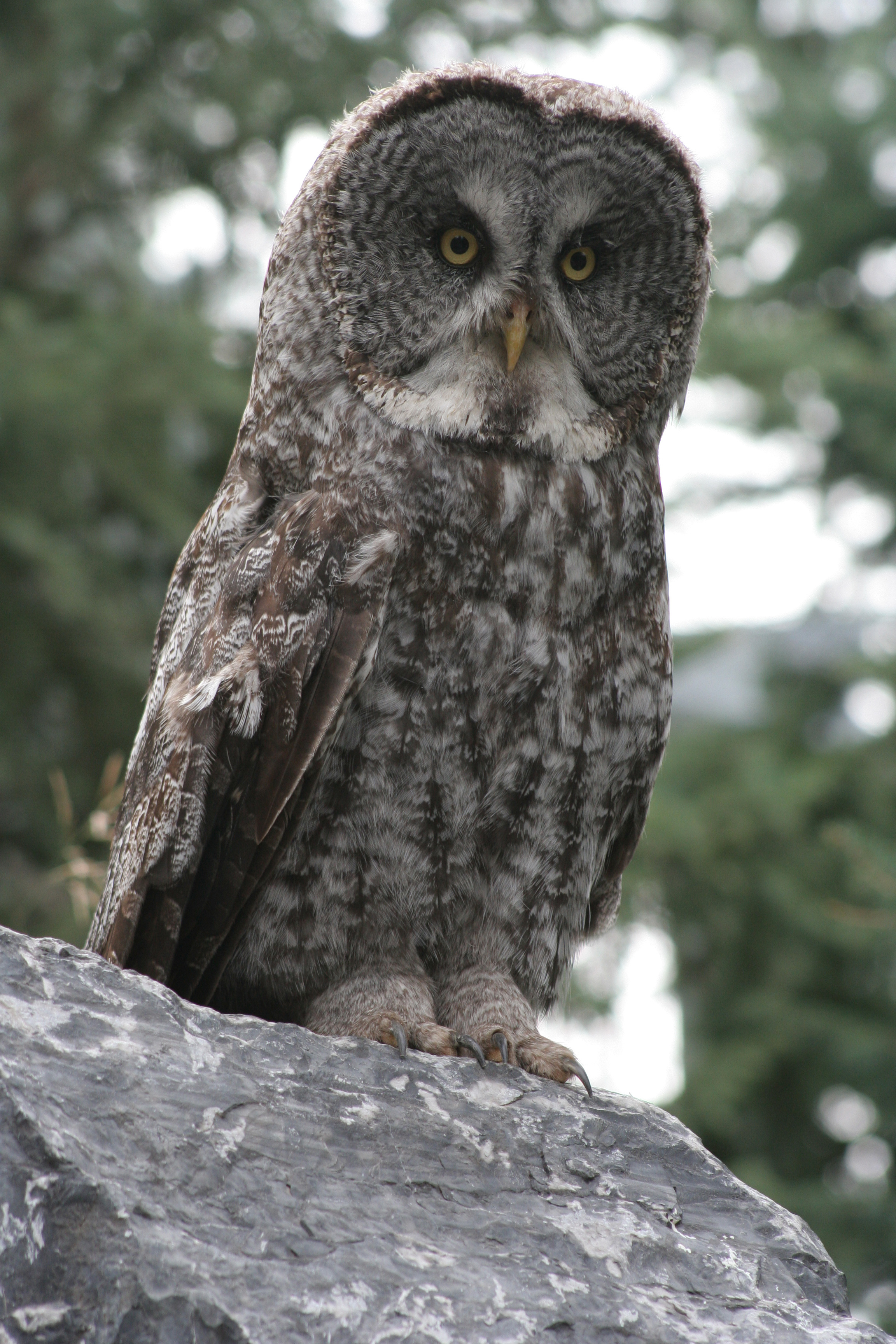
The great grey owl (Strix nebulosa) is the largest owl by length in North America, though the great horned owl and snowy owl surpass it in mass. Its enormous facial disc functions as a parabolic reflector, channelling sound to its asymmetrically placed ears with precision sufficient to locate voles and meadow mice moving beneath deep snow.
Great grey owls breed in the boreal and sub-boreal forests of central and western Canada, nesting in abandoned raptor nests, broken snags, and occasionally in natural tree cavities at higher elevations. Their hunting method — hovering or perching quietly before plunging through snow to seize prey — is among the more dramatic foraging behaviours documented in Canadian birds.
The species is largely nomadic at a multi-year scale, tracking vole and lemming population cycles across the boreal. In years of prey scarcity, great grey owls irrupt southward in numbers that occasionally bring them to agricultural fields and suburban parks well south of their normal winter range — spectacles that draw birders from across the continent.
Beaver: Engineer of the Wetland Mosaic
The beaver (Castor canadensis) does not fit neatly into the conventional predator-prey framework, but its role as an ecosystem engineer warrants attention in any account of boreal keystone species. By felling trees, building dams, and flooding river valleys and creek bottoms, beavers create ponds, wetlands, and meadows that would not otherwise exist.
These human-made wetlands — or rather, beaver-made wetlands — provide habitat for waterfowl, amphibians, fish, and a wide range of invertebrates. They slow water flow, reduce downstream flood peaks, and allow sediment deposition that can improve water quality. The historical extirpation of beavers across much of their range in the nineteenth century, driven by the fur trade, reduced wetland coverage across North America; their recovery following legal protection has been associated with measurable increases in wetland area in many regions.
In the boreal forest, beaver activity creates the shifting mosaic of wet meadow, open water, shrubby riparian edge, and drowned forest that characterizes many river valleys. Moose, waterfowl, and a suite of less conspicuous species depend on these environments. The beaver's interaction with the boreal forest — eating aspen, birch, and willow — also influences forest composition and structure at local scales.
Interconnected Dependencies
The species described above do not function in isolation. Woodland caribou avoid areas frequented by wolves; wolves follow moose distributions shaped partly by beaver activity and forest structure; lynx track hare cycles that themselves respond to vegetation recovery after fire; great grey owls depend on the small-mammal communities whose diversity reflects the mosaic of forest ages and wetland types maintained by fire, flooding, and decay.
The integrity of these relationships — their capacity to self-regulate, recover from disturbance, and maintain the conditions that other species require — depends on the availability of sufficiently large and connected areas of boreal forest. Fragmentation, even when individual patch sizes remain large, alters the effective connectivity of the landscape for species with large home ranges and low population densities. This is the central ecological argument underlying conservation targets for intact boreal ecosystems in Canada.